In today’s fast-moving construction and industrial sectors, time is money. Businesses want warehouses, factories, and commercial facilities built as quickly as possible without compromising quality. This is where Pre-Engineered Buildings (PEB) are transforming the construction industry.
Unlike traditional construction methods, Pre-Engineered Buildings use prefabricated steel components manufactured in factories and assembled on-site, which significantly reduces construction time—often by up to 50%. Many leading peb manufacturers are now delivering advanced building solutions that help industries complete projects faster and more efficiently.
In this blog, we’ll explore how PEB structures accelerate construction, improve efficiency, and provide cost-effective solutions for modern steel structure building projects and industrial facilities.
What Are Pre-Engineered Buildings (PEB)?
A Pre-Engineered Building (PEB) is a steel structure building designed and fabricated in a factory and assembled at the project site. Instead of building every element on location, the building components are engineered beforehand and delivered ready for installation.
PEB structures are commonly used for:
- Industrial buildings
- Warehouses
- Logistics hubs
- Cold storage facilities
- Retail buildings
- Manufacturing plants
Because of their precision engineering and prefabrication, PEB structures drastically reduce the time required for construction. Many peb manufacturers specialize in designing and producing these structures to meet the growing needs of modern infrastructure.
Why Pre-Engineered Buildings Reduce Construction Time by 50%
1. Prefabricated Components Speed Up Installation
One of the biggest advantages of PEB construction is that most building components are manufactured in factories before arriving at the site.
These include:
- Steel columns
- Rafters
- Roof panels
- Wall cladding
- Structural frames
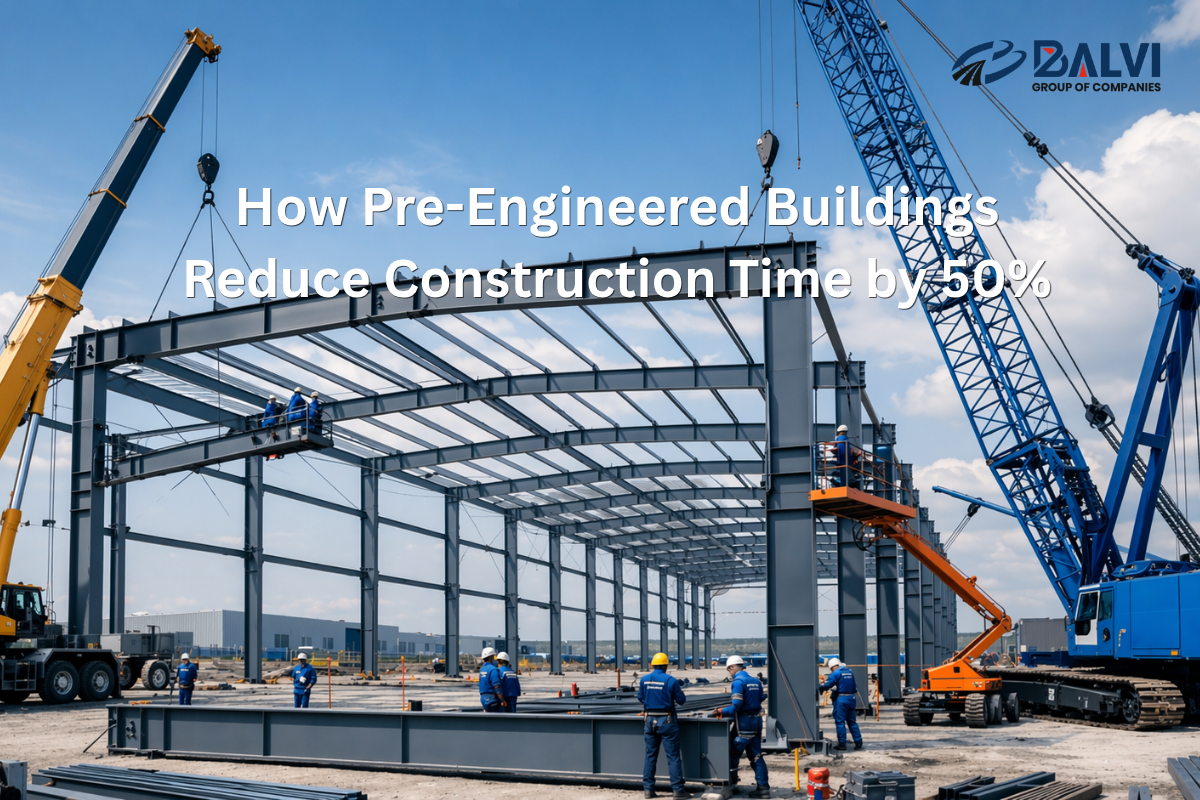
Since these prefabricated steel components are already fabricated, workers only need to assemble them on-site, which saves weeks or even months of work.
Result:
Traditional construction timelines shrink by 40–50%. Many peb manufacturers use advanced manufacturing technologies to ensure faster production and accurate fabrication of building components.
2. Parallel Construction Activities
In conventional construction, many activities must happen one after another, which slows down the project.
With Pre-Engineered Buildings, multiple processes happen simultaneously:
- Site preparation happens on-site
- Steel structure fabrication happens in the factory
- Roofing and wall panels are prepared in parallel
This parallel workflow significantly accelerates project completion for any steel structure building project.
3. Faster Structural Assembly
A PEB steel structure is designed with bolt-together connections, which simplifies installation.
Instead of:
- Cutting steel on-site
- Welding complex joints
- Adjusting structural elements
Contractors simply assemble pre-engineered parts using bolts and fasteners.
This reduces:
- Labor time
- Skilled workforce requirements
- On-site fabrication work
The result is rapid warehouse construction and faster completion of any steel structure building.
4. Reduced Construction Errors
Traditional construction often faces delays due to:
- Design changes
- Measurement errors
- Material shortages
However, PEB structures are engineered using advanced design software by experienced peb manufacturers, ensuring precise measurements and accurate fabrication.
Because everything is pre-designed and pre-tested, there are fewer on-site corrections, preventing delays and saving valuable time.
5. Simplified Foundation Requirements
Compared to traditional concrete structures, steel PEB buildings are lighter, which means they require simpler and faster foundation work.
Benefits include:
- Reduced excavation time
- Lower concrete usage
- Faster curing time
This contributes to shorter construction schedules and lower costs for steel structure building projects.
6. Faster Roofing and Wall Installation
In pre-engineered warehouse construction, roofing sheets and wall panels are pre-cut and ready to install.
This allows workers to quickly:
- Install roofing panels
- Attach insulated wall cladding
- Seal joints efficiently
Because these materials are factory-finished by specialized peb manufacturers, installation becomes faster and cleaner compared to traditional masonry work.
7. Minimal On-Site Labor
Since most components arrive ready for assembly, PEB construction requires less manual labor on-site.
Benefits include:
- Reduced dependency on large labor teams
- Faster installation
- Lower risk of delays due to workforce shortages
This makes PEB buildings ideal for large industrial projects and steel structure building developments where timelines are critical.
Additional Benefits of Pre-Engineered Buildings
Apart from faster construction, PEB structures offer several other advantages.
Cost-Effective Construction
PEB buildings reduce material wastage and labor costs, making them more economical than conventional buildings.
Flexible Design Options
PEB systems allow customization for warehouses, manufacturing units, and commercial buildings.
Durability and Strength
Steel structures are highly durable, corrosion-resistant, and capable of withstanding extreme weather conditions.
Eco-Friendly Construction
Because materials are factory fabricated and optimized by experienced peb manufacturers, PEB construction produces less waste and supports sustainable building practices.
Industries That Benefit Most from PEB Construction
Pre-engineered buildings are widely used across industries that require fast and scalable infrastructure.
These include:
- Logistics warehouses
- Cold storage facilities
- Manufacturing plants
- Retail distribution centers
- Industrial sheds
- Agricultural storage buildings
Companies that rely on rapid expansion and operational efficiency prefer modern steel structure building solutions developed by reliable peb manufacturers.
Conclusion
The demand for faster, cost-effective, and reliable construction solutions has made Pre-Engineered Buildings one of the most popular choices in modern infrastructure development.
By using prefabricated steel components, parallel construction processes, and simplified assembly techniques, PEB structures can reduce construction time by up to 50%.
For industries looking to build warehouses, industrial buildings, or logistics hubs quickly, PEB construction offers the perfect balance of speed, strength, and efficiency.
As technology and design capabilities continue to evolve, steel structure building solutions developed by leading peb manufacturers will play a major role in shaping the future of industrial construction.